How to Pick a Great Launch Date with Astrology
Imagine this… You’ve just put the final touches on your new online course. It’s taken you six months (six months!!) of hard work, but it’s finally, finally done. You’re so proud and can’t wait to sit back, relax, and watch the sales roll in.
You press publish and…crickets. Nothing. Nada. Zilch. It’s not because your new creation sucks. It’s more likely because you didn’t check the astrology before pressing go.
Launching something without checking the astrology is like driving at night without headlights. It just ain’t safe…or smart. You’ve worked so hard on this new creation, and it deserves as much cosmic momentum as it can get! In this post, I give you my easy, five-step process for picking a great launch date with astrology.
Why You Should Use Astrology to Pick a Launch Date
Using astrology to pick a launch date ensures that your project gets the most support it can. It takes a little extra effort, but it’s worth it. When you pick a strategically-aligned date, the launch tends to go more smoothly, and the outcome is typically closer to your ideal.
If you don't take the astrology into account when you're launching, you might unintentionally launch during astrology weather that’s downright unfavorable, full of friction, or too quiet to make a splash.
If you want a more effortless launch experience (especially after all that hard work you just did), grab your favorite astrology calendar (here’s mine), and let’s pick a date.
Before we go deeper, I want to mention that what I share here is a more beginner-friendly version of picking a date. I'm skipping the heavy-duty astrology. There's a lot more to this art (which is called electional astrology) than what I'm sharing in this post. But this will get you started for free without a professional. (And it’ll still have pretty stellar results.)
Step One: Give Yourself Realistic Parameters
When you’re picking an astrological date, please give yourself parameters. Otherwise, you’ll have way too much astrology to sift through and you’ll want to cry from overwhelm.
Start with the practical bookends first, then layer in the astrology. Ask yourself: When will I realistically, practically, actually be ready to launch this thing? Pro tip: give yourself more time than you think you need. Delays always come up. Be kind and plan for them.
I suggest picking a two-week date range, maybe a month at the most. For example, let’s pretend I anticipate my new program will be ready May 1st. I’d look at the two weeks following May 1st for a launch date, perhaps all of May if my astrology chops can handle it.
When I pick launch dates for my clients, I require them to give me parameters. This ensures that I’m not sifting through a whole year’s worth of astrology. That’s too much. We’re not searching for a needle in a haystack here.
Now that you’ve practically narrowed your launch window down to two weeks, it’s time to block off any days that just don’t make sense. This has nothing to do with astrology and everything to do with reality.
For example, maybe you block off weekends because they’re not ideal for product launches. Or, maybe you block off a day where you’re already pretty busy because you don’t want to overload your nervous system. Smart. Cross those days off!
Step Two: Get Clear on Your Desired Outcome
Take some time to think about what it is you really want out of this launch. Do you want a lot of people to see it? Do you want a lot of sales? Do you want to feel proud and confident? Is it positive reception and celebration?
Get crystal clear on what you actually want out of this experience. For example, if you want a lot of people to see your new product, you’ll want to make sure that the Sun, the planet that represents visibility, is extra strong on your launch date.
If you want lots of sales, you might want to highlight Jupiter. If it's positive reception and good reviews, you might want to focus on Venus. If it's buzz, interaction, and engagement, maybe go with Mercury. If it's confidence, you might choose the Sun or Mars.
Think about your desired outcome, and then pick the planet that represents it most closely. Pro tip: You may want to pick a runner-up planet too, because perfect dates don’t exist. Sometimes you just have to do the best with the astrology you have.
Step Three: Eliminate with the Moon
The amount of light that the Moon is reflecting describes the visibility of the product or service that you're launching. It describes whether or not it’ll be seen by the public For most launches, you want the Moon to be as bright as possible.
If that’s the case for you, open up your calendar and cross out any days where the Moon is dark. I define this as anywhere between the Last Quarter Moon and the next Waxing Crescent Moon. This especially includes the Balsamic Moon and the New Moon (which is technically completely dark).
If you notice that the Moon is dark for the entire two-week period you initially chose, that’s a clue to make a shift. No problem! The Moon always returns to fullness—just wait a few days.
The darker Moon phases are ideal for other things, just not visibility. But if you wanted to do a soft launch or a beta test, a dark Moon phase might be exactly what you need. Again, it's all about the desired outcome.
Another thing I want you to be mindful of is if the Moon is void of course anywhere during the remaining dates. This is when the Moon isn’t making aspects to other planets.
If your desired outcome is visibility, longevity, and interaction, you don't want the Moon to be void and wandering in the abyss during your launch. You want it to be social and making aspects to other planets.
Step Four: Prioritize the Ideal
Remember that planet you picked in step two that represents your ideal outcome? It’s that planet’s time to shine. You want the planet symbolizing your desired outcome to be in the best position possible on the day of your launch.
What do I mean by best position possible? Well, in simplified terms, I mean:
1. It’s in a zodiac sign it likes.
2. It’s making a helpful aspect.
A planet “likes” being in the sign of its domicile or exaltation. But you’re not always going to have that option. So we’ll settle for that planet not being in its sign of fall or detriment. Check the table below to see which signs certain planets “like” and “dislike”.
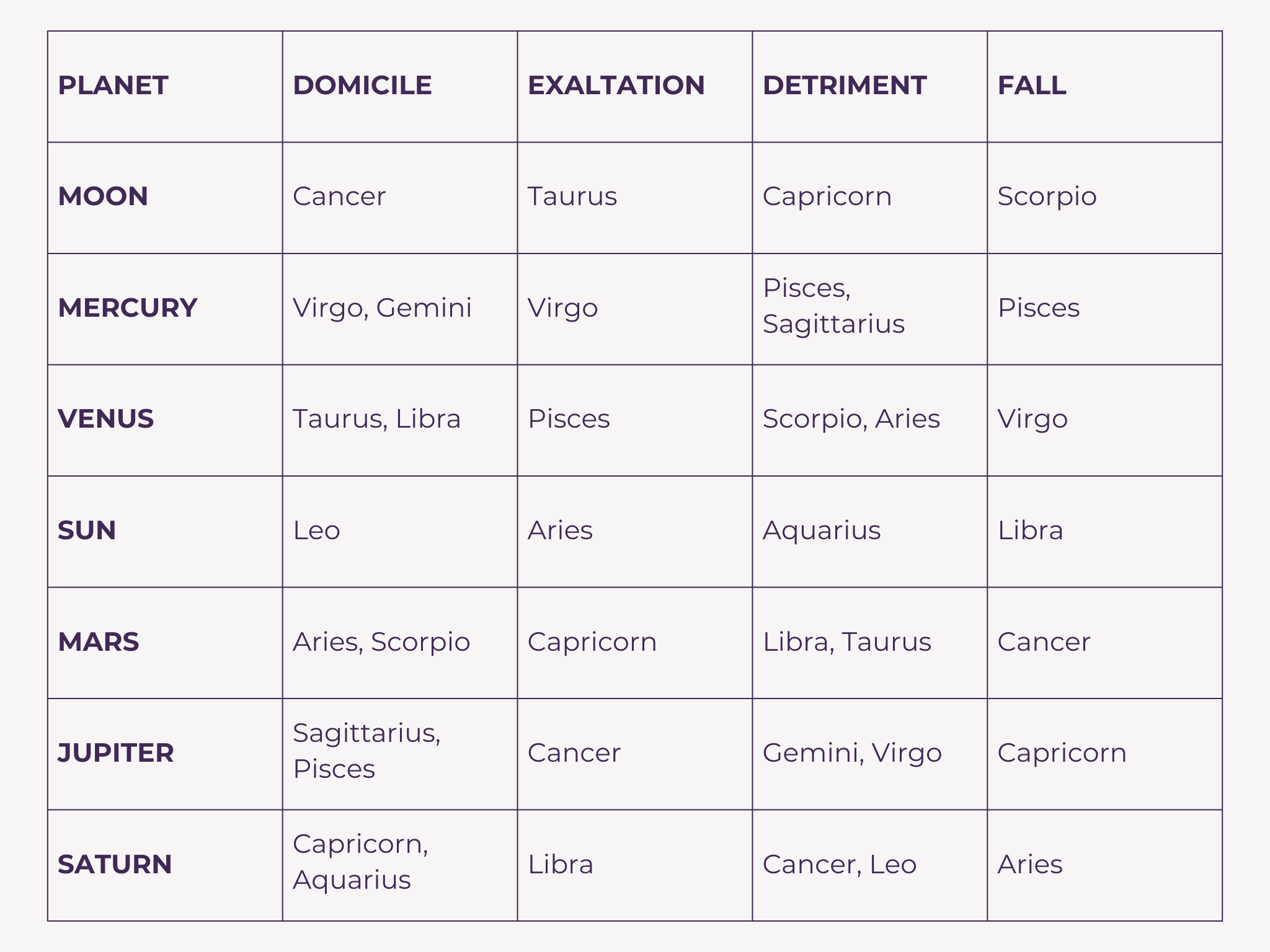
A helpful aspect might look like a trine, sextile, or conjunction with one of the luminaries (Sun* or Moon), or a benefic planet (Venus or Jupiter). I’d even take a square or opposition from Venus, Jupiter, or the Moon to my planet of choice.
*A conjunction with the Sun is actually unfavorable, but that’s for another blog post. (Short story: A conjunction with the Sun will make your outcome planet invisible, which nullifies the whole thing.)
You want to avoid your outcome planet making or receiving an aspect from Mars or Saturn, especially a conjunction, square, or opposition.
You could stop here, and you’d have a pretty amazing date. But if you want to take it further, there’s always more astrology where this came from…
Step Five: Pinpoint the Exact Moment
So, you've picked the day, but there's a lot going on in that 24-hour period. For this step, you’re either going to need professional software, or you're going to need to be a whiz at using a free online astrology tool.
Ideally, you want to choose the time of day where your outcome planet is the ruler of the ascendant or the first house. For example, let's pretend you're launching a book, and you decided that the outcome you want is engagement. You want buzz, you want people to talk about it, and you've chosen Mercury as the planet as your outcome planet.
In this case, you’d ideally want a Gemini or Virgo rising chart, which would make Mercury the chart-ruling planet.
Next, make sure that the chart ruler (Mercury in this example) is in a supportive house, or on an angle. The angles are the ascendant, descendant, midheaven, and the imum coeli. The most supportive houses are the angular houses (1, 4, 7, 10), as well as the 5th and the 11th. But if you can get the chart ruler in the 10th house—chef’s kiss.
Be aware that the rising or ascendant sign changes about every two hours. So if you want a different rising sign, just move the chart forward an hour or two.
And finally, in an ideal world, you want the launch chart to play nice with your natal chart. You want there to be some type of connection between the two, meaning there's some type of positive aspect between both charts. For example, maybe the Moon in the launch chart is conjunct your natal ascendant, midheaven, Venus, or North Node.
It doesn’t have to be huge. Even a small nod to your natal chart will do. But I’d definitely prioritize this because, at least in traditional astrology, everything is meaningless unless it’s rooted in the radix (aka the natal chart).
Whew—that was a lot of astrology! But I hope this was brief enough and clear enough to get you started.